Friday, 19 September 2008

Jupiter again

Jupiter is starting to get higher in the sky, but the conditions have been dreadful for a long time now. When it hasn't been raining its been threatening rain. All this adds up to lots of cloud cover.
Anyway, last night - just for a while, some of the sky was visible. There was still scattered cloud around, but less than normal and I could see Jupiter shining out - still not that much above the horizon.
I could also see that a couple of houses away, they had some sort of light show going on in their garden, as their tree's were backlit - hmmm!
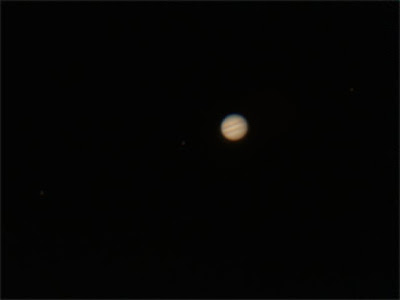
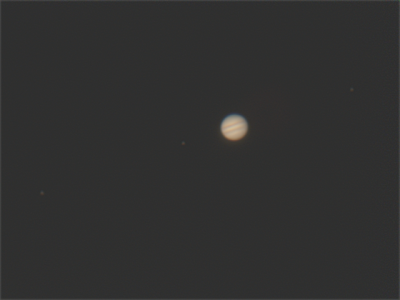
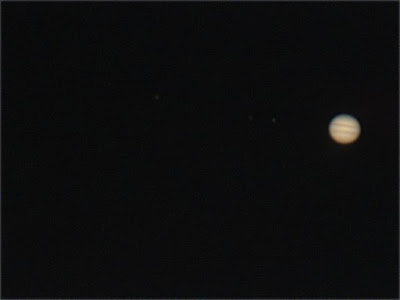
Anyway - I had a go, the telescope aligned and settled on Jupiter very nicely. With the LPI I took some images and got some reasonable results.


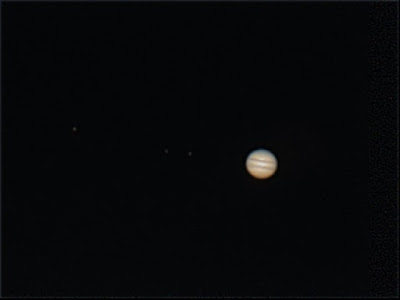
With a bit of enhancement you can see some of the satellites too.

From left to right, Ganymede, Io and Europa on the right.

Then I got it to find Andromeda, nope - nothing, far too hazy and messy in that direction.

Wednesday, 30 July 2008

Jupiter in the round

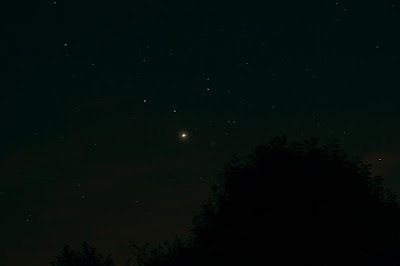
A quick look outside and its a clear night. I can't be bothered to set up the telescope, but I take a look through binoculars at Jupiter, which is looking quite clear. As I watch, I see the ISS go overhead!

Anyway, I decide its worth a photograph, so I get out the camera and tripod and take a few snaps at various settings to see what I can get. Its nothing like what you see in the telescope, but it makes for a nice assemblage.

If you zoom in, you can see the motion blur dragging the points out into streaks, and this is only a 10s exposure, but from a distance it looks pretty ok. Zoom in not quite so far and you can see some of the satellites.

Wednesday, 23 July 2008

Jupiter - another go

I had another shot at Jupiter last night. With the telescope on the patio, I have a window of about 15-20 minutes when it is visible between two trees. This time I got set up a little earlier and managed two separate imaging samples. The visibility wasn't that great with it low on the horizon, and again it didn't look as good through the LPI webcam as through the lens. I guess the old mark one eyeball still has a useful range and pixel density.
You can see three of the satellites however, so that's a little better.

Also this time I had the settings right so I could post process the images with registax, which I think does a better job than envisage.


I might try a different technique if I get a chance.

Monday, 21 July 2008

Jupiter

Its been a while - but now the nights are getting a little earlier and I can be bothered to stay up. Also there is a new jewel in the sky, in the shape of Jupiter, so its time to have a go and see what can be got.
Its not easy, Jupiter is low in the sky between some trees, and after a few goes, the only place I can get a good view of it is from in the middle of a wooden bridge. This is not ideal, as everytime I move, the image leaps around. Even so, its the first go and the images are okish, but would be better if I'd saved them in a better format.


Maybe another night I'll have a better go, and remember a few more things. You can see a couple of moons, but its not as clear as it is through the eyepiece.

Tuesday, 6 May 2008

The moon and mercury

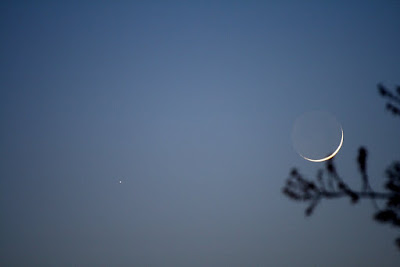
Its been a while since I took any photos of the night sky. What with some foul weather, and a dose of flu that had me confined to bed for a week, the opportunities have been thin on the ground. However tonight it was clearish, although some hazy cloud around, and I wondered about looking for some M object or other to try and photograph. However checking with a few star charts, and with stellarium, it seems Mercury might be visible soon after sunset.
Its in the west obviously, which is not a good view from our garden. A whacking big house being in the way for one! However we have a balcony on the front of the house that we never use, which I thought might be useful. It turns out to be an excellent platform for this. Being on the first floor, its not too far being at roof top level, or at least looking over the houses across the street is only 1 or 2 degrees from horizontal.

Anyway, I scanned the sky anxiously as the Sun set. Stellarium showed the moon would be lined up with Mercury, but such a thin wedge that it might not be visible. Eventually after much scanning, and not a little ridicule from the neighbours, I spotted a thin rim of the moon.
About 30 minutes later, as it got darker, there was Mercury - right where it should be!

Thursday, 10 April 2008

Saturn again

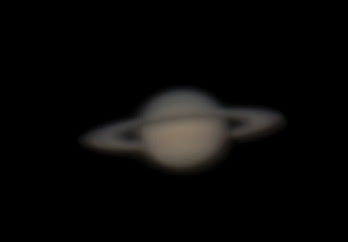
Last night, I spent a long time trying images of Saturn. I've got a new motorised focuser, which finally means I can focus in an out with out any perceptible shake of the image. This makes it a little easier getting an image into focuser, although its still a lot of trial and error.

This is the best of the pictures from last night.

Tuesday, 8 April 2008

An iridium flare

Last night was a great night for observing orbital things, in theory. The space shuttle, a number of rocket bits and pieces and various other satellites were all scheduled to pass overhead.
However, that was the theory. In practice there was an awful lot of cloud about. None of that wispy mostly transparent stuff. No, this was thick piled up stuff as dense as you like. But - it wasn't wall to wall, at least not all the time.
Anyway - I went out to try and spot the ISS - although it was a bright pass, the time was not good, as the sky was still a faint bluey colour, the sun not having set very long ago. I could see a couple of the brighter stars after a while and the ISS should be magnitude -1.8 which is brighter than pretty much anything else in the sky other than the moon, but it wasn't looking good for the 3rd magnitude rocket bit that was coming over at the same time. I managed to spot the ISS eventually, but it wasn't the bright object it normally was.

I skipped most of the other passes as they were not very bright and with the large covering of cloud, would be difficult to spot. However there was an iridium flare scheduled for about 5 minutes to 10. The iridium satellites are a whole group of orbiting communication satellites, that have a highly polished panel attached, that if it happens to be in just the right orientation reflects the sun very brightly. There are programs to predict these events, I used the heavens above site.
I set up my point-and-shoot digital camera on video mode on a tripod pointing roughly in the right direction to try and spot it. I waited until about the right time, and then pressed the button and hoped that it was pointing about right, and that nasty bank of cloud would not obscure it.

What do you know, I saw it and caught it too!


It looks better at the original resolution, but you can see a bright dot at least. It is magnitude -7 or so, which is very bright indeed.