Showing posts with label nebula. Show all posts

Tuesday, 21 October 2008

Deep sky

After buying some more stuff (mostly batteries and USB leads - so relatively cheap) I had another go at some deep sky stuff. I've never really seen the andromeda galaxy, but tonight I did see it, and photographed it too! However the photographs will need some work I think, but here are some preliminary pictures.

This one shows it rather overenhanced, but you can also see the small galaxy just above it.

Wednesday, 5 March 2008

Another go at the orion nebula

I tried some rather short exposure settings on M42, but decided this time to try some 25s exposures with the DSLR mounted at prime focus on the telescope. I wasn't sure that the telescope would track well enough. Also Orion is just above the house and descends below it through the night, so not an ideal location either. Anyway - worth a try.

It turned out that many of the images had elliptical stars, or were smeared out, but there were a number within the 25 taken that looked ok.

I used DSLRshutter program to take them which worked pretty well. I also experimented with nebulosity for focussing without much success.

Anyway - after throwing lights, flats, darks and biases at deep sky stacker, it pronounced that only one of the images was worth stacking... its probably right but it could have broken the news gently!

Anyway, its probably my best shot of M42 to date, but still not much compared with anyone who's any good!


Step by step, its getting a bit better.

Tuesday, 5 February 2008

Deep Sky

I had tried out some deep sky images with my new camera, but was rather disappointed in the results. I know I shouldn't expect great results on the first try, but all the images showed some degree of movement of the stars. Either this was camera shake because of the action of the mirror moving, and me pressing the button (but I tried using the "hat" trick to avoid that and they were still there). Otherwise it could be the motors on the scope not tracking as accurately as I hoped.

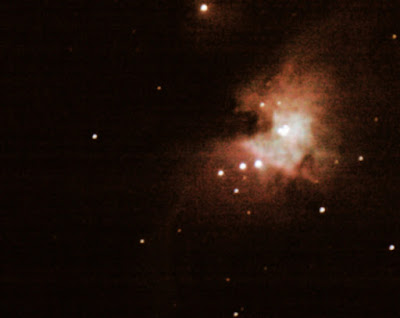
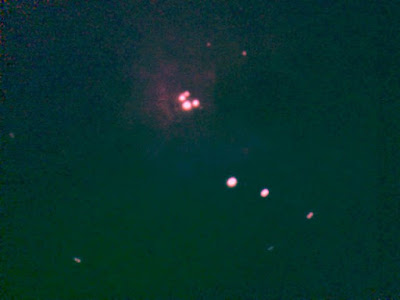
Last night I decided to experiment, and tried the LPI, which was not designed for deep sky objects, on M42 in Orion. I was reasonably impressed with the results. With an exposure setting of just over a second, the results were quite good.

After a bit of post processing, the stars are obvious and there is even a bit of nebula glow.


Better than with the camera anyway.

Friday, 1 February 2008

A new camera - and a clear night

My new camera arrived - a Canon EOS 400D. The good news about this is that it will do long exposures. It will do timed exposures up to 30s, and has a bulb setting for arbitrary times.

The bad news is it is quite a complex bit of kit, and will take some time to get to know how to use it.
The good news - its a clear night. The bad news - I'm not even sure how to switch on the camera, let alone use it.

Still - a clear night is not to be wasted, so I set up the equipment, and managed to get the camera attached to the back of the telescope with the appropriate adapters. Focusing was as difficult with this as with the LPI interface I soon found out. I also managed to confuse myself a number of times with the mirror setting. This allows you to either view from the top or straight through, but typically I'd find the right star with the normal eyepiece, then try and focus the camera and find it pitch black. Then it would tumble - I had to switch the mirrors over!

I tried some images of M42 and got some results, which is more than I'd ever done before. They weren't very good though. The wind was howling around and a number of roads had been closed to high sided vehicles, so it wasn't a good setting for long exposures. I also found that the mirror movement caused blurring and although I think there is a setting to disable that, I didn't know what it was. I reverted to the hat-trick - where you cover the lens, press the shutter, wait for a second for it to steady, then uncover the lens. I also covered it up towards the end of the shot for good measure. The wind continued to come in gusts though.

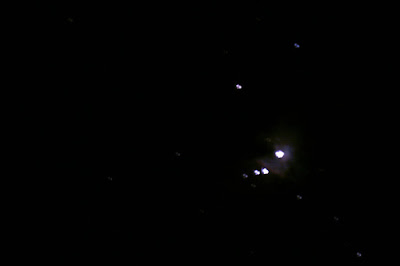
However with a bit of fiddling around on one of the better shots I go something that looked nebula-ish.


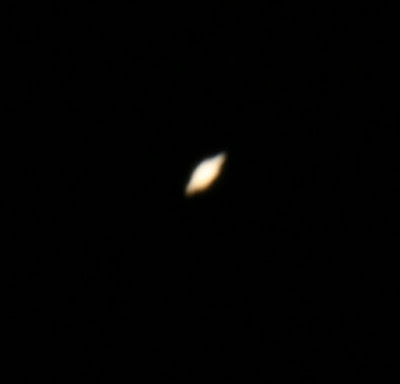
I tried Saturn too, but just guessed at the exposure, and it came out over exposed. I was getting very cold fingers by this time!


I then took some more images of Saturn with the LPI experimenting with the FITs save format, but couldn't get registax to accept them in any reasonable way.

Tuesday, 8 January 2008

My first guided telescope.


So with Christmas over, and no telescope found under the tree, I decided its time to buy something more serious. Like a number of hobbies, you can spend an inordinate amount of money on equipment without trying really. In the end I opt to buy a Meade ETX 125 PE. This is partly because it currently has an offer which includes a number of additional lenses and filters which adds considerably to the value. It has on it a list of things I wanted which includes

  • A GOTO system - after alignment you can tell it to go and locate a given star or planet.
  • A computer interface allowing possible remote control of the telescope from a PC.
  • A reasonable diameter mirror (127mm/5inch).
  • The pack of eyepieces, which range from 40mm (47x mag) to 6.4mm (297x). There is also a barlow lens which allows the doubling of all above magnification.
  • A built in equatorial wedge - this allow the telescope to track in a plane the same as the stars rotate in - so only one direction of track required. Normally it works in Alt-Az mode - which means it has two motors one that moves it around in a circle, and the other is up and down.
I also bought a power tank, which is like a big battery - and can be used for jump starting cars, but supplies enough power to keep the telescope functioning for a number of hours. Finally a small CCD camera which drops in, in place of the eyepiece and can be used for basic moon, planet and other imaging. It can also be used to guide the telescope in conjunction with the computer interface above.

Wonder of wonders, after I get home and play with my new toy in the daylight, the skies clear as it gets dark and I can try it for real.
I tried just looking through it initially, and it was a lot clearer. Then I tried aligning it in auto mode. This is very clever, although it takes 2-3 minutes, which if like me you have to do a few times gets boring quickly. First it finds north, then it works out what the tilt and inclination is, and then it selects where it thinks two stars are it can align with. Well the first star it picked I had no idea - it could have been one of several. I found out later pressing the ? button tells you what star it is thinking it should be, and with stellarium running nearby, this helps a lot. I also found you can skip stars that might not be visible. It is rather sensitive to being interrupted while slewing though. Also realigning without power cycling seems to give rather odd results.

Also so far, the alignment isn't very exact, by picking two widely separated stars it seems to improve. You end up somewhere nearby what you're interested in, but its not always even in the field of view. I'll have to recheck I have input all the correct details.


Mars when viewed was a lot clearer, as were some other things I looked at. After that I spent a while installing the camera software and working out how to get that to go. Then I tried some imaging. This required the laptop close by so the USB cable would reach, and a bit of experimentation.

The results were not too bad, but not as good as I'd hoped - but all this was within a few hours of getting the kit out of the box, and learning how everything worked from scratch. So I guess I should carry on and see what can be done.

Mars was still readily accessible.


Saturn rose - but due to the location I'd picked it rose in between the branches of a tree, and there was intermittent cloud cover, so I was lucky to get anything.

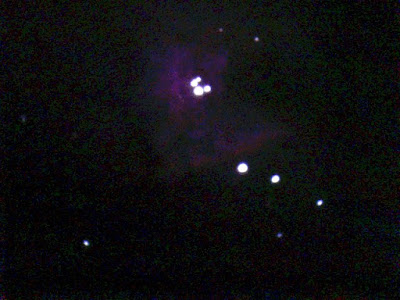
I tried a deep sky object too - the Orion nebula in this case.

Not bad I suppose altogether for day 1.